

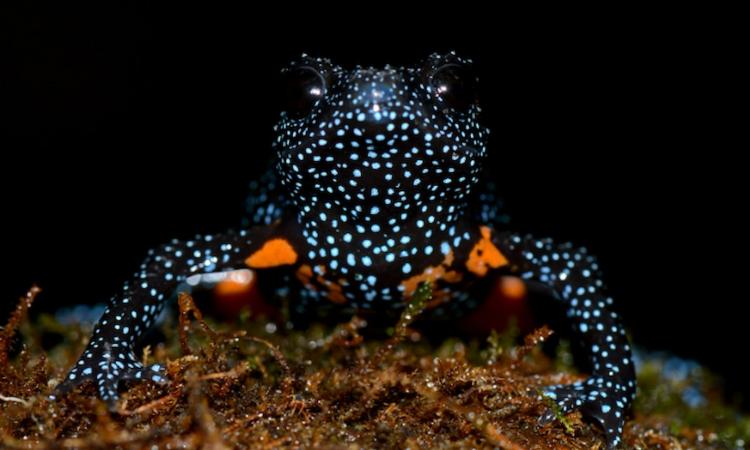
With its pale blue speckles and bright orange patterning, the galaxy frog (Melanobatrachus indicus) looks less like an amphibian and more like a fragment of the night sky. Yet, a new report published today in Herpetology Notes by the Zoological Society of London (ZSL) warns that our desire to capture this beauty on camera may have led to the disappearance of a local population in India’s Western Ghats.
Researchers returning to their study site between August 2021 and May 2022 failed to find any of the seven frogs they had previously recorded beneath rotting logs in early 2020. The findings suggest a "tragic irony": the drive to document these rare creatures has likely contributed to their local demise.
Lead author Rajkumar K P, a fellow of ZSL’s EDGE of Existence Programme, attributes the loss to severe habitat disturbance following several unregulated photography trips. The team found overturned logs, trampled vegetation, and no traces of the tiny amphibians in the area, which sits near the Mathikettan Shola National Park in Kerala.
An anonymous informant reported that between June 2020 and April 2021, groups of photographers used high-intensity flash settings—risking dehydration and stress for the moist-skinned frogs—and handled them without gloves, drastically increasing the chance of disease transmission.
“Named after their stunning resemblance to images of space, these beautiful yet rare frogs are unlike anything else on our tiny corner of the universe – but without careful and responsible management, we risk them disappearing off the face of the planet for good,” says Rajkumar. He adds, “It would be a tragic irony if a drive to capture their likeness on camera today turned them into a thing of the past.”
The galaxy frog lives only in shaded forest patches of the southern Western Ghats, typically nesting under logs and stones. However, the conversion of these forests into coffee and tea plantations has already pushed the species to Endangered status on the IUCN Red List.
As the sole member of its genus, it is classed as an Evolutionarily Distinct and Globally Endangered (EDGE) species. It represents an irreplaceable branch of the tree of life—one that ZSL works globally to safeguard.
Dr Benjamin Tapley, ZSL’s Curator of Reptiles and Amphibians and co-author of the study, stresses that photography remains a double-edged sword.
“Sharing beautiful photographs and video clips of animals – especially animals like frogs that don’t benefit from the same universal adoration as some other species – can be hugely beneficial for their conservation,” Tapley explains. “A picture can inspire someone to care, to learn more, to take action; but that picture-perfect moment should never come at the cost of the animal’s wellbeing or its home.”
This incident is not isolated. Unethical photography has previously led to bans on bird nest photography in Indian competitions and restrictions on photographing the Great Indian Bustard during breeding seasons.
The report calls on photographers, tourism companies, and authorities to adopt a strict code of ethical field practice. Key recommendations include:• Restrict the use of flash to prevent stress and dehydration.
• Never handle animals to avoid disease transmission.
• Minimise habitat disturbance, ensuring logs and vegetation are left exactly as found.
• Implement mandatory training or penalties for breaches of these standards.
Such measures are essential to ensure that wildlife photography supports rather than undermines conservation. We must ensure that we observe nature respectfully, leaving only footprints and taking only memories—and ethical photos.
ZSL’s EDGE of Existence Programme works with grassroots conservationists worldwide to safeguard species like the galaxy frog from extinction.
This article was curated, reviewed, and verified by the Conservation Mag team.
Information provided by the Zoological Society of London.
Clicking links may earn us commission. . Stock images by Depositphotos.
Welcome to Conservation Mag where we celebrate nature preservation through ecotourism and wildlife travel while we look for ways to preserve our heritage by supporting nature conservation. Starting conversations about the positive action people like you and I are taking to make a change.
