


The squids were fresh. He was looking for buyers in the early morning heat of a Timorese landing site at the capital Dili. His t-shirt was black, the letters white, the message blunt: It won’t fail because of me. I bought the squid and asked if I could photograph his chest. He said yes, with the mild indifference of someone who had never considered what the slogan might mean to a malae (foreigner).
Some months later, a paper landed that brought that t-shirt back to mind. Cepić, Ančić, and Škacan, published the results of their survey to fishers across commercial, recreational, and subsistence fleets in Croatia (Cepić et al., 2026). They found something that will surprise no one who has spent time in fishing communities, yet it had never been so cleanly measured: fishers consistently attribute less blame for environmental degradation to their own group and more to others. Industrial fishers blame artisanal ones; artisanal fishers blame industrial fleets; commercial fishers close ranks against recreational ones. The pattern held across every fleet segment surveyed, and it strengthened with structural distance — the more different another group was in scale, gear, and market position, the more blame they received. Hell, as the authors note with a nod to Sartre, “is other people”.
Discourses
Years before that photograph was taken, and before Cepić and colleagues had put numbers to it, I had been trying to make sense of a similar grammar in a fishing community on the northwest coast of the Iberian Peninsula. I was there as a researcher, carrying out fieldwork for my doctoral thesis (Alonso-Población, 2010). The pattern I found was, as it turns out, almost identical to the one measured in Croatia: the other was always guilty of dwindling resources.
Recording and codifying those redundant discourses quickly became tedious. I realised that the reasons given for the blame — the why—were less revealing than its direction and its boundaries. Who was the we doing the blaming, and who was the other receiving it? That reframing allowed me to identify that the boundaries between self and other were not fixed. But most importantly, this reframing enabled me to unveil two types of discourse. The first I called refraction: blame directed outward, deflected to a third party, always performed in public spaces. The second I called reflection: blame turned inward, toward neighbours, toward subgroups within the community itself. Reflection happened only in private. (Alonso-Población, 2014)
But there was a third variant, and it only revealed itself under specific conditions. A variant I have since come to think of as radical reflection — a discourse by which the community turned blame not just inward but toward a kind of collective reckoning. It did not appear in public spaces, nor even in the semi-private conversations that reflection required. It required trust. The kind that accumulates slowly, through presence, through time, through the willingness to sit for hours with someone as they work, the kind of trust that is earned around a meal.
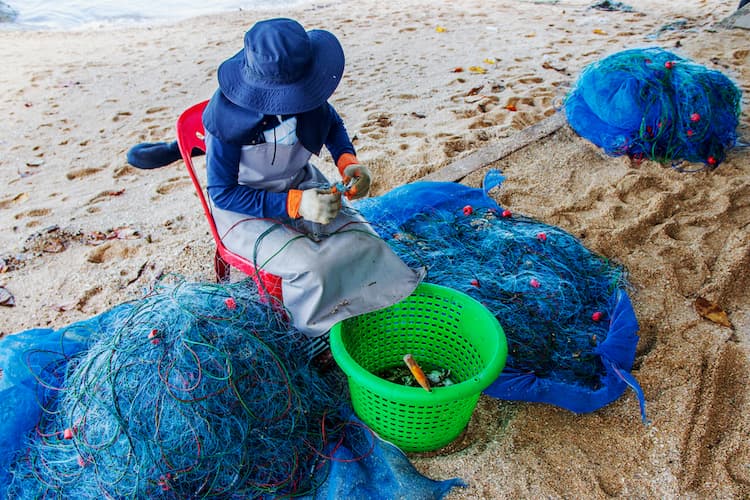
The first revealing example I registered came from an older woman, a vessel owner, with whom I had built an unusual degree of confidence over many months. She was mending a net in the port when she said it, almost in passing: "Se [as institucións] nos deixan a nós [sen supervisión], queimamos o mar." If they leave us without oversight, we burn the sea. It was a confession of complicity, of a relationship with the sea that pivots between dependency and destruction; a recognition of a unique capacity for harm. It was also the kind of thing that is never said to a stranger, never said in a meeting room, never said where it might be used against the speaker. It was said because she had decided, over time, that I was worth the risk.
Encounters
My first encounter with Timorese fishing communities came in June 2009, when I arrived as a researcher. Along the coast, I found outboard engines — locally called johnsons — sitting idle on beaches and in yards. They had been distributed during the post-conflict reconstruction period; handovered by state and non-governmental organisations, arriving faster than the supply chains needed to sustain them. Outboard engine oil was expensive and largely unavailable, so fishers mixed coconut oil into the fuel. Maintenance was improvised or absent. The engines had become monuments to a particular kind of development logic, and the fishing communities had a name for it. "Governu foo deit" — the government just gives away stuff. Rather than a complaint about generosity, the statement was a precise and damning critique of an aid architecture that began as a post-relief approach and lasted far longer than it should have.(Alonso-Población et al, 2013). As an external researcher, I was a safe audience for that critique.
I returned in February 2010, this time as a practitioner, working for an international aid project. The communities were the same. The coastlines were the same. But the encounter was different, and so was what I was told. In field visit after field visit, the message was consistent: "Amy prezisa johnson.We need outboard engines. Not repairs. Not oil. Not training. (Alonso-Población & Fidalgo-Castro, 2016).
My new role — practitioner, with a project budget, institutional backing — had activated a different register. The community members were doing what all social actors do: reading the encounter and responding to what it made possible. The 2009 researcher had been a safe audience for critique; engines were pointed with the finger as symbols of a failed model. The 2010 practitioner was a potential source of delivery, and I was at last being asked to reproduce the model. The discourse had not changed because the problem had changed. It had changed because I had. And without that distinction clearly in view, the practitioner will always misread what they are being told.

Refractions
The very idea of refraction captures something precise: in physics, it describes the change in direction of a wave — most commonly light — as it passes from one medium into another. The ray arrives from one direction and exits in another; the source is not moved, but made to appear so.
A common thread running through the two cases examined here is that at the source of both discourses, there is failure and attribution. EU fishers — both in Galicia and in Croatia — face evident ecosystem degradation and the decline of fishing resources, and are confronted by a legal framework that deposits on them a great responsibility, communicating in practice who is the primary group bearing the brunt of accountability. The Timorese fishers faced the evident failure of the development aid architecture that could not resolve economic hardships and did not fulfil the promises of advancement; yet delivered stuff with no accompaniment at the needed scale, at least by 2010. Refraction discourses are, in this light, a coping strategy, a defence mechanism against an accountability that, while not without foundation, is rarely distributed evenly, and whose terms were never theirs to negotiate. The relevance of these discourses rests in their performative dimension, that is, in their capacity to create real-world outcomes. As Cepić and colleagues (2026) note, blaming others for environmental degradation may have important repercussions on producers' behaviour, serving to morally justify harmful and illegal conduct or to minimise fishers' sense of responsibility for the state of resources (see Cepić and Nunan, 2017).

Yet the practitioner is neither a passive nor a neutral recipient of statements, and their actions also create real-world outcomes. Two parallel mechanisms shape what the practitioner hears, and both perform at the encounter. The first builds up before the encounter begins. As Donna Haraway argued (1988), there is no knowledge from nowhere; the practitioner arrives already primed by training, institutional affiliation, and the worldview their own social position has quietly installed. The second mechanism operates in real time. Social psychology has long shown that empathy is not evenly distributed, and that it is felt more readily toward members of our own social group (Cikara et al., 2014; Fourie et al., 2017). In their encounter with the outgroup individual, the practitioner’s empathy deficit creates a specific risk: that empathy — which requires a deliberate intellectual effort to understand the other on their own terms — is displaced by sympathy, defined as an awareness of the other's suffering as something to be alleviated, but felt from a distance, and from above (see Davis, 2018). The latter positions the other as an object of concern rather than a subject of knowledge.
This is where the encounter typically yields two divergent situations. The practitioner either adheres uncritically to the fishers' discourse or dismisses their statements entirely in favour of technical fixes. Both options amount to the same failure: they reject the search for a multi-situated understanding, reduce complexity, neglect history, and deny the power dynamics that facilitated the very discourses being heard. Simplifying the problem leads to simplifying solutions — and both, with uncomfortable frequency, produce silver bullet approaches. Silver bullets, by definition, lack intellectual humility: they mistake a partial account for a complete diagnosis, refuse to sit with uncertainty, and remain closed to views that complicate rather than confirm (Michaels et al., 2023). The distortion is further compounded when uncritical adherence is directed not toward the least powerful actors in the room, but toward industry giants, powerful retailers, or corrupt officials whose discourses carry institutional weight precisely because of the power they already hold.
Reflections, and the way forward
It won’t fail because of me: the practitioner, too, rarely chooses this thought. It arrives with the authority yielded by their academic credentials, the institutional backing, or the project budget.But avoiding failure asks for something none of those supply: the slow, unglamorous work of building trust with those who carry the leverage, the willingness, and the incentives to align their interests with change — until they decide, over time, that you are worth the risk.

References cited
Alonso-Población, Enrique, (2010). Riesgo, Cultura y Trabajo. Un Estudio de Caso de la Pesca en Galicia.Unpublished Doctoral Dissertation. Department of Humanities, Universidade de A Coruña.
Alonso-Población, E., Wilson, C., Rodrigues, P., Pereira, M., & Griffiths, D. (2013).Policy and Practice : Recommendations for Sustainable Fisheries Development in Timor-Leste. Regional Fisheries Livelihoods Programme. Policy Paper TIM No. 2. Food and Agriculture Organization of the United Nations. https://doi.org/10.13140/RG.2.1.1993.1608
Alonso-Población, E. (2014). O mar é femia. Riesgo y trabajo entre los pescadores de una villa costera gallega. Madrid: Ministerio de Educación, Cultura y Deporte.
Alonso-Población, Enrique, and Alberto Fidalgo-Castro, (2016)."‘Governu fó deit [the government only gives away stuff]’ versus ‘Ami presiza Johnson [we need an outboard engine]’: Paradoxes of Two Encounters with Timor-Leste Fishers." Working paper presented at the Workshop Visions of the Future in Timor-Leste, University of Kent, School of Anthropology and Conservation, April 15–19, 2016.
Cepić, D., & Nunan, F. (2017). Justifying non-compliance: The morality of illegalities in small scale fisheries of Lake Victoria, East Africa. Marine Policy, 86, 104–110. https://doi.org/10.1016/j.marpol.2017.09.018
Cepić, D., Ančić, B., & Škacan, M. (2026). How fishers attribute blame for marine ecosystem degradation: developing a social relational approach to conflict in capture fisheries. Ecology and Society, 31(1), art36. https://doi.org/10.5751/ES-17086-310136
Cikara, M., E. Bruneau, J.J. Van Bavel, and R. Saxe. 2014. Their Pain Gives Us Pleasure: How Intergroup Dynamics Shape Empathic Failures and Counter-Empathic Responses. Journal of Experimental Social Psychology 55: 110–1258
Davis, M. H. (2018). Empathy: A social psychological approach. Routledge.
Fourie, M. M., Subramoney, S., & Madikizela, P. G. (2017). A Less Attractive Feature of Empathy: Intergroup Empathy Bias. In Empathy - An Evidence-based Interdisciplinary Perspective. InTech. https://doi.org/10.5772/intechopen.69287
Michaels, S., Auld, G., Cooke, S. J., Young, N., Bennett, J. R., & Vermaire, J. C. (2023). Conservation, uncertainty and intellectual humility. In Environmental Conservation (Vol. 50, Issue 4, pp. 196–201).Cambridge University Press. https://doi.org/10.1017/S0376892923000176
Please Log in or Create an account to join the conversation.
Clicking links may earn us commission. . Stock images by Depositphotos.
Ask the Wise Baobab
Legend says I know everything. Ask for guidance on wildlife, travel paths, and our mission to give a voice to the voiceless.
Welcome to Conservation Mag where we celebrate nature preservation through ecotourism and wildlife travel while we look for ways to preserve our heritage by supporting nature conservation. Starting conversations about the positive action people like you and I are taking to make a change.
