
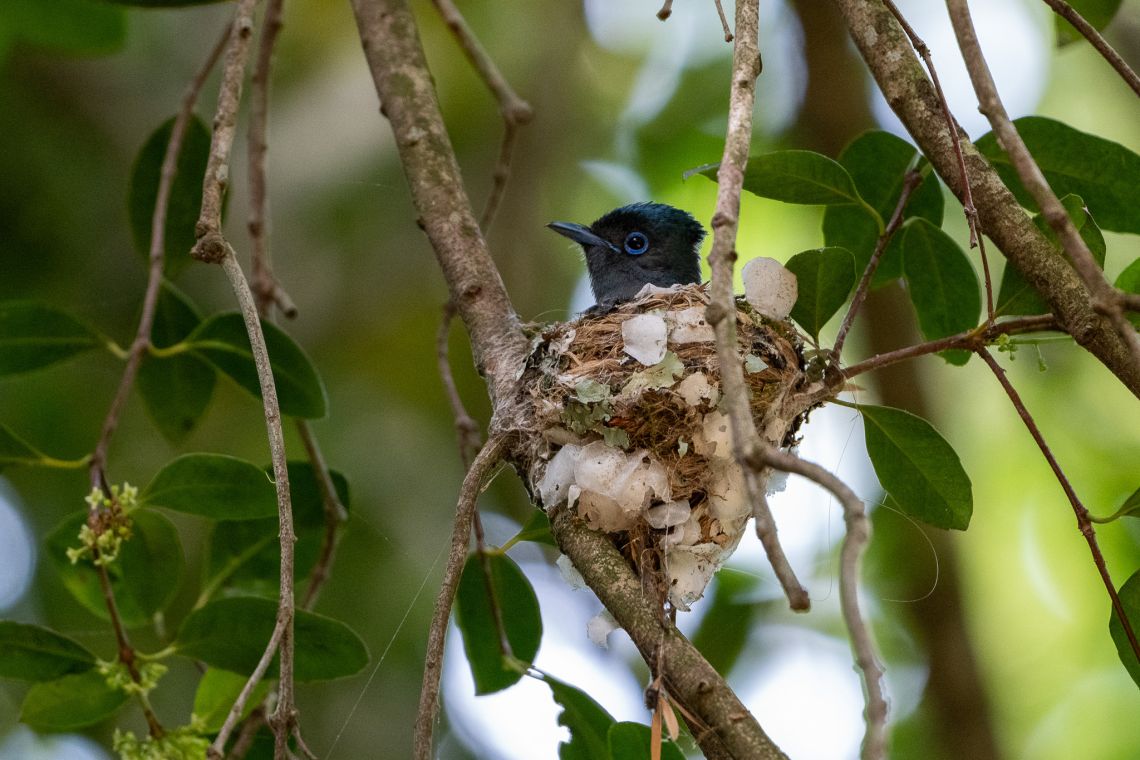
In the first field note, I wrote about the autofocus issues I encountered with the male paradise flycatcher. Taking photos of the female offered many more focused subjects. But, the interesting thing I have noticed about my workflow is the bias toward trying to spend hours getting the perfect male shot to include its beautiful tail, ignoring the fact that, or at least leaving it till later to develop the female version of the photo.
Interestingly, the paradise flycatcher shares egg incubation. The female sits on the nest while the male feeds, and vice versa. While the female leaves the nest, the male watches over the new brood.
This time, the Nikon Z6iii performed slightly better in slightly better light, which gave me a slightly wider range of poses. Or was it due to slightly better contrast compared to the background? This photo was shot with the Nikkor Z 180-600, 1/640, f/6.3, ISO 6400. The photos of the male flycatcher ranged from ISO 8000 to 9000. This photo has been cropped slightly, and I added a mask to the bird, increasing the exposure by 0.24.

