Helping to preserve the unique ecosystems of Isabela Island, the largest and least inhabited of the Galápagos Islands, is the Intercultural Outreach Initiative (IOI). IOI receives local support, as well as support from the Ecuadorian government and international organizations, while organizing volunteer opportunities that attract people from many parts of the world. IOI’s mission statement reads like this:
“To provide technical and financial support to local organizations in the promotion of projects for economic development, social equity, and environmental sustainability to create a community that is responsible and respectful of society and the environment in which it lives.”
A Warm Welcome
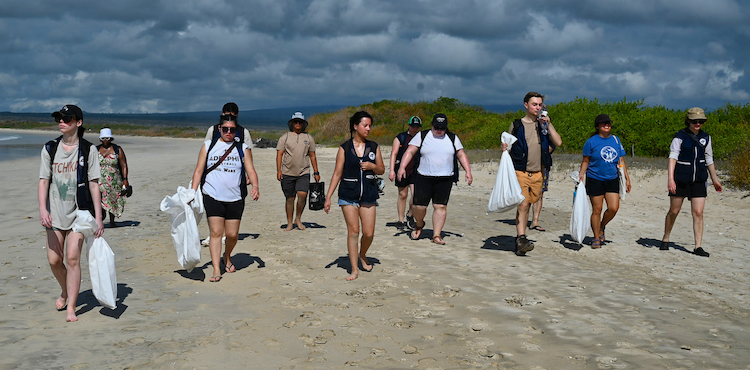
The enthusiasm of the full-time Ecuadorian staff is palpable as they greet and orient new groups of volunteers who have made the trek from numerous parts of the world to work in IOI’s projects: sustainable farming and urban agriculture, endemic plant species nursery, removing invasive species, social media, ecotourism, Galapagos tortoise conservation, or just about anything that will help keep the wild and beautiful landscape of the Galapagos protected and thriving. Volunteers, for example, from Adelphi University, New York, spent a community-service week recently staining the boardwalk leading to Concha y Perla, a popular place also for snorkeling and seeing sea lions resting on the dock or sunning on a bench along with the world’s only aquatic iguanas (Amblyrhynchus cristatus). In addition, the Adelphi students wrestled invasive grass from a beach, bagged kilos of trash from the beach, and creatively painted volcanic rock walls of the local school, then were treated to a performance by students of traditional Galapagos dancing. Similar work was also done by students from the University of Miami.
The invasive species control activities carried out by IOI also include the sterilization of dogs and cats in Puerto Villamil, in partnership with the Galápagos Biosecurity Agency (ABG) and the Animal Balance Foundation. At a clinic located on the road to the dock, free veterinary brigades are organized. Community members bring their pets to be treated, sterilized, and dewormed.
Local School and Teaching the Importance of Sustainable Agriculture
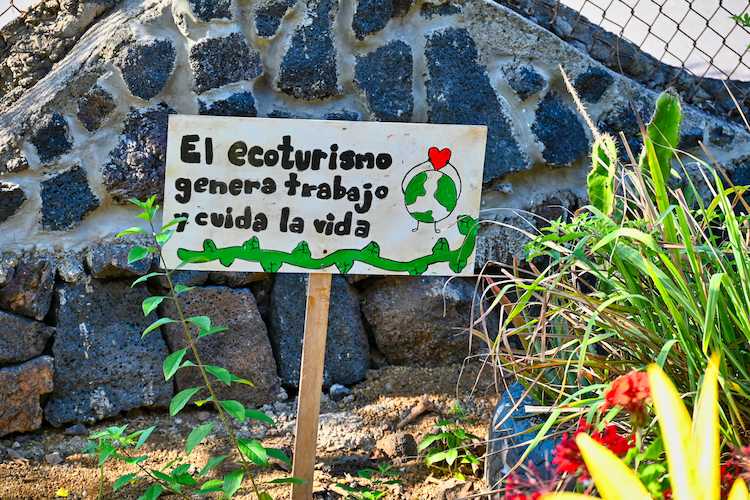
The Adelphi students walked to the nearby Catholic school, Unidad Educativa Fisco Misional Inmaculada Stella Maris. The group was taken on a tour of the school grounds and their extensive gardening projects that the children tend to. They play an active role in environmental conservation and gardening, and learn about sustaining the fragile ecosystems of the islands they call home. No pesticides are used. IOI provides interactive classes on organic gardening, environmental education, personal development, and sustainable cooking classes using the produce grown on the school grounds. In this way, the children can help improve the way cooking is done at home, organically. All around the school grounds were used tires, cut into creative planters, hanging used soda bottles for seedlings, and raised beds for vegetables. A lagoon is being rebuilt, and native species of birds are returning. As Sara Luz Ruiz, the Director of the IOI Foundation, stated, “The children are growing up in nature, and that’s beautiful.” As they walk into the school kitchen, they literally see the fruits of their labor – ripened cherry tomatoes, for example, and other produce to be cooked into delicious, healthy meals with the help of their teacher, Nichole Palacios, who teaches cooking and organic gardening.
Agroecological Fruit and Vegetable Production: Finca Santo Remedio
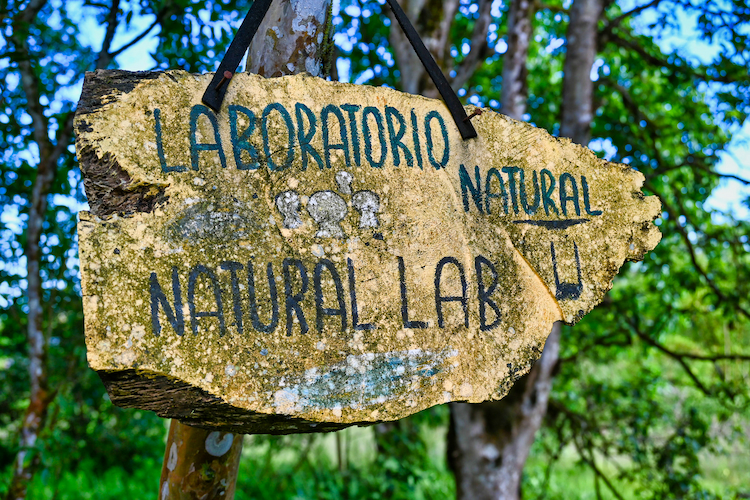
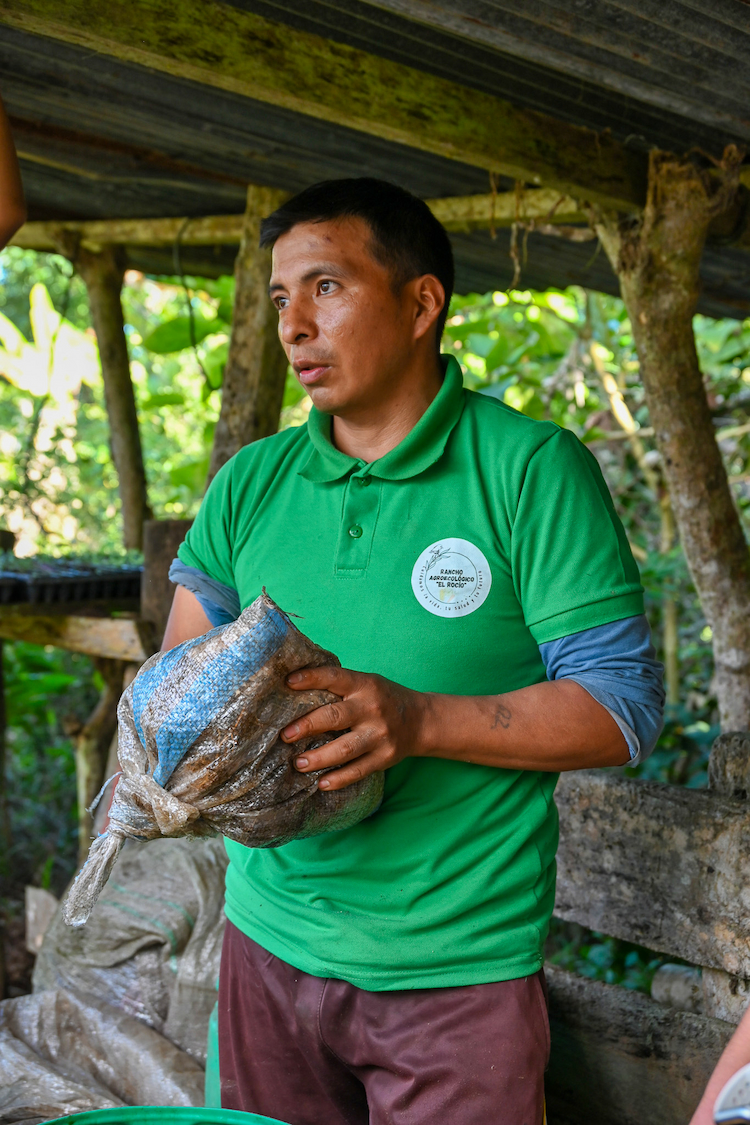
IOI has a growing presence on the southern part of Isabela Island as it collaborates closely with communities, local schools, individuals, and vegetable farmers, ecologically growing fruits, vegetables, and now, coffee. Thirty-five vegetable and coffee farms receive training in many aspects of organic farming. One example of this is Finca Santo Remedio, an agroecological farm managed by Don Hernan, committed to learning a sustainable way of farming. Don Hernan is focused on improving the quality of citrus production, working with techniques such as grafting, rootstock selection, and other agroecological practices that help increase productivity while reducing the need for inorganic fertilizers. Don Hernan manages his farm as a diverse system, combining short-cycle crops with fruit trees to keep the soil productive and healthy. His gardens include peppers, beans, cucumbers, and white onions. Crop diversification plays an important role in his agroecological approach and shares his knowledge with visitors. By rotating crops, the soil is less likely to become exhausted, so he works consistently with organic fertilizers, especially compost, which he prepares and applies across different areas of the farm to improve soil fertility and strengthen plant growth naturally. Don Hernan’s San Remedio agroecological farm is part of the growing transition of Isabela Island towards organic farming only.
Diversity, Adaptation, and Respect for the Land
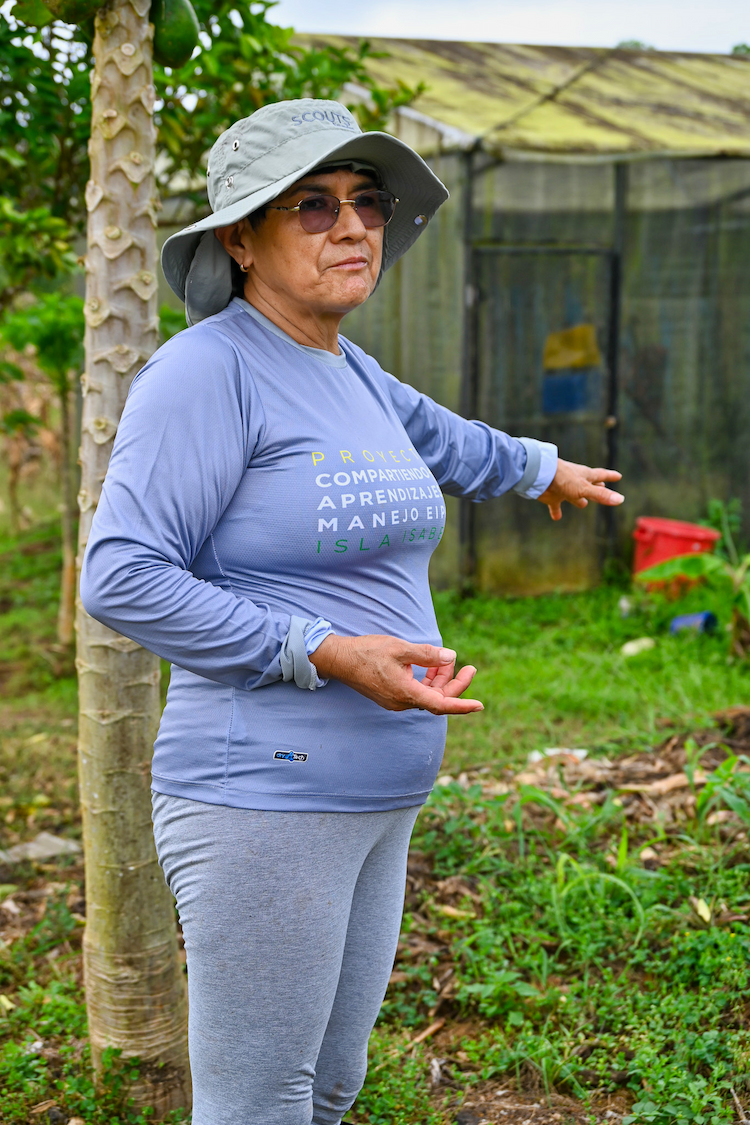
Doña Carlota’s organic fruit and vegetable farm may be small in size, but it is great in spirit. Carlota took part in a year-long learning process in 2025, offered by field schools and extension programs such as Heifer and IOI. Because she applied agroecological methods, the quality of her produce is visible – she uses no chemical products for clearing weeds, using only her hands and simple machinery. Her mindset is organic only, and her production is diversified: papaya trees, corn, pineapples, beans and cilantro, and in her small greenhouse, she grows peppers, melons, cucumbers, red onions, and herbs – all maintained with homemade organic fertilizers. She understands the need for crop rotation, decided upon by the condition of the soil, the season, and the farm’s needs.
The Fledgling Coffee Industry on Isabela: Conservation and Care of the Land
Finca de los Naranjos
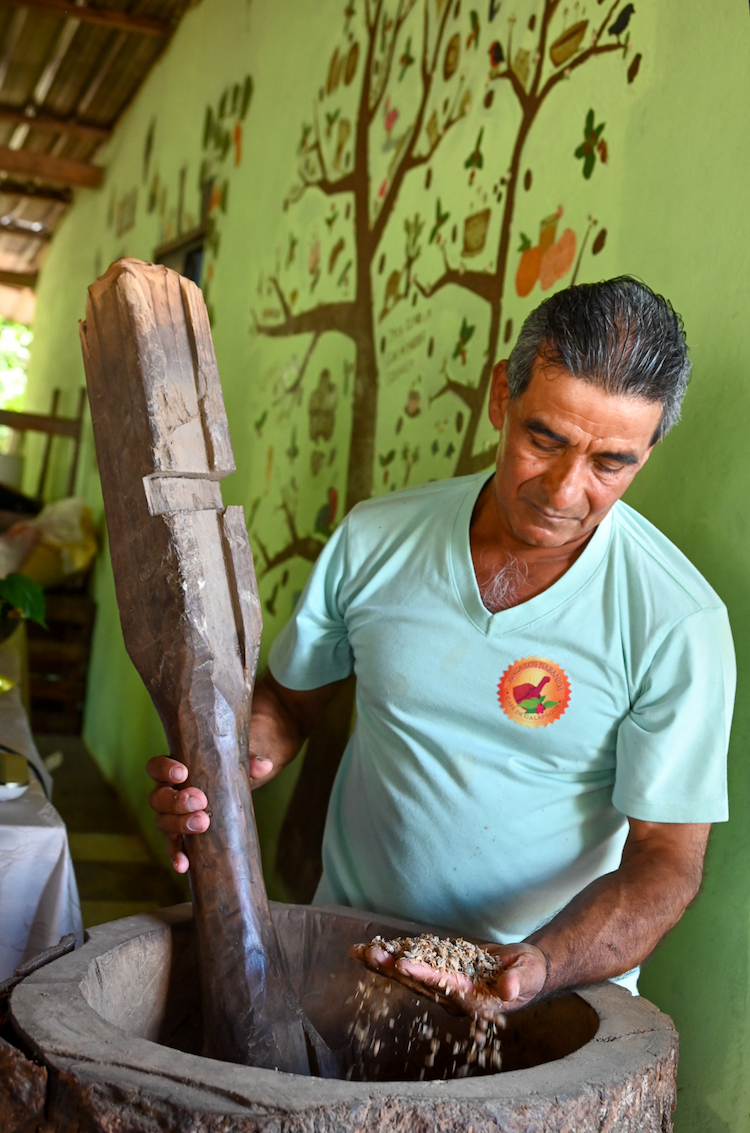
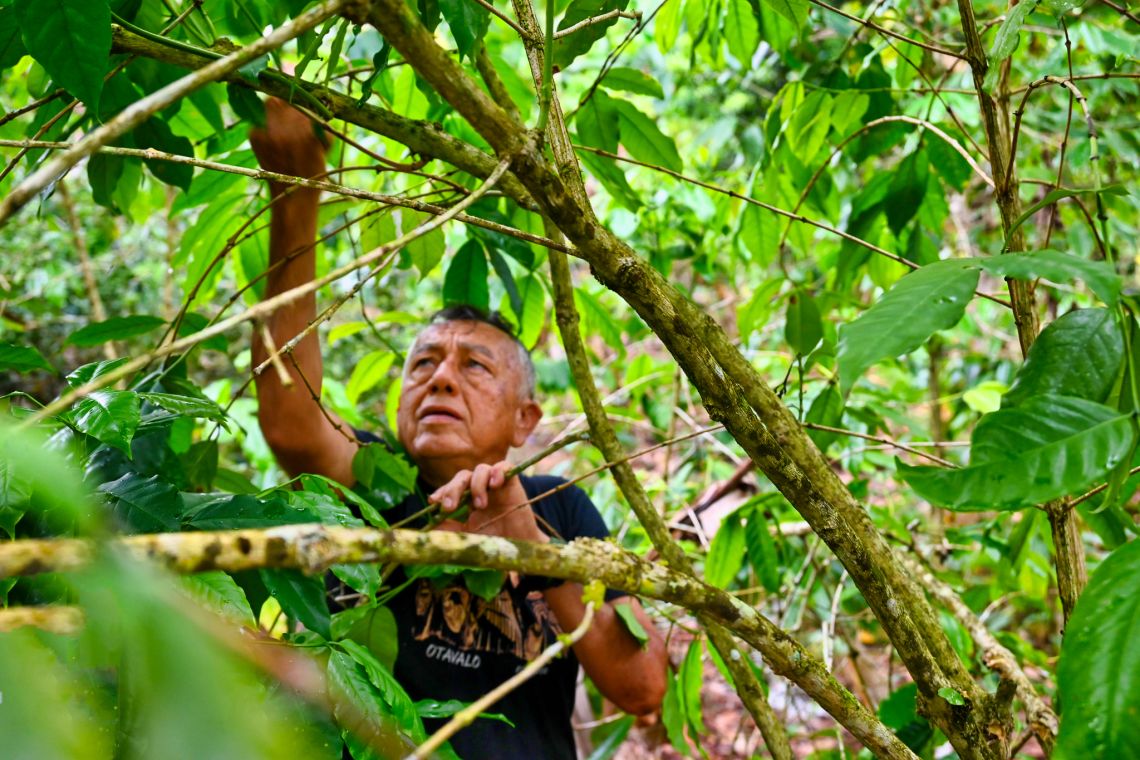
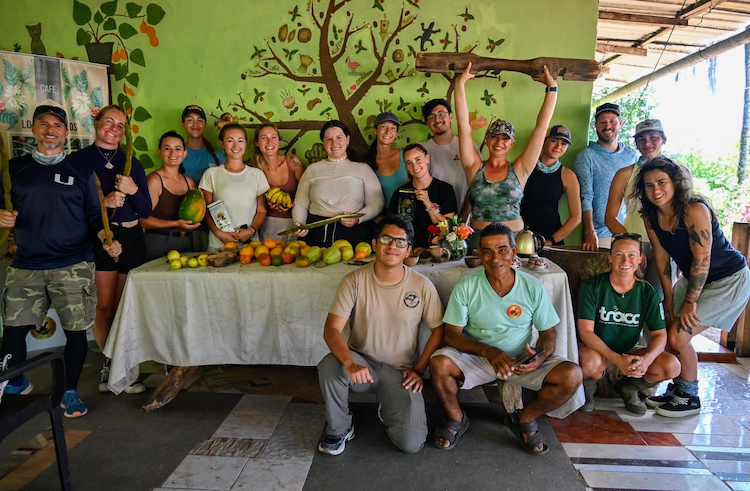
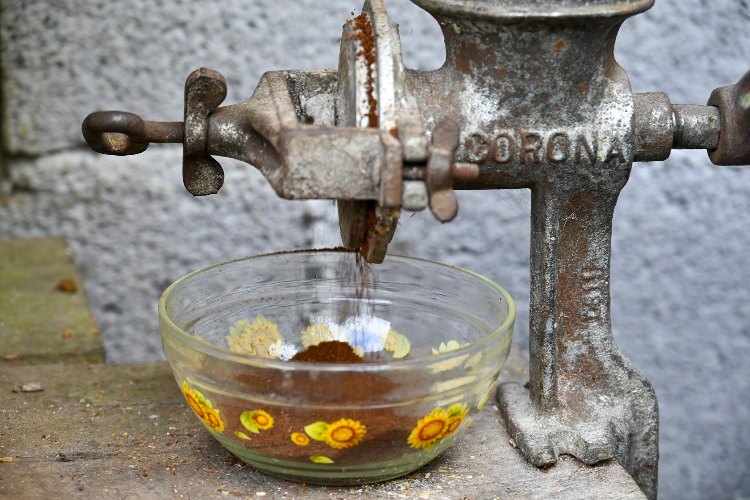
One of IOI’s most recent initiatives is to support the reintroduction of coffee as a sustainable crop. One coffee farm grew into seven with the efforts of Walter Osorio, whose family came to Isabela to grow coffee many years ago. Don Osorio, who now owns the farm, decided to try more than one variety of coffee by experimenting with growing different varieties in the favorable micro-climate of San Cristobal. The 300-meter altitude and frequent cloud cover provide conditions favorable for coffee. Seeing Don Osorio at work on any day to maintain his coffee plantation without machinery of any sort demonstrates the hard work and dedication needed to grow a quality coffee. After being picked, his beans can take up to three months to dry because of the region’s climate, and once ready for processing, the beans go into a very large, wooden mortar and pestle, which Don Osorio uses to remove the outer layer of the bean. He then puts an electric fan in front of the beans, and he drops them into the mortar to separate the beans, now ready for hand roasting, which takes about fifteen, very closely supervised minutes to keep the beans from burning. Finally, he puts the roasted beans into a coffee grinder, which he turns by hand. The scent of the coffee grinds is far-reaching, and visitors eagerly await the taste of freshly brewed coffee from Finca de Naranjos. IOI has provided workshops on coffee growing, and all of Don Osorio’s growing practices are strictly organic.
The Finca de Los Cuatro Hernános
At 500 hectares, Los Cuatro Hernános (The Four Brothers) Farm is the largest coffee farm on Isabela Island. Don Flavio Gomez grew coffee on Isabela Island about 45 years ago, when Isabela was known for its coffee production. However, due to conservation priorities and lack of economic viability for coffee farming, the industry declined until recent times, when a back-to-the-land movement has gotten underway on Isabela. Today, the farm, managed by Don Gomes, the son, has approximately one to one and a half hectares of coffee, mostly the Típica variety (local coffee). This is not a recently planted plantation in large rows, but rather a coffee field that has been renewed over time through pruning and natural regrowth, keeping the strongest plants that continue to sprout and grow. In addition, Don Flavio has also planted new coffee plants recently—around 160 young plants—as part of the farm’s renewal process.
The farm follows a 100% organic approach. No chemical products are used to control weeds or fertilize the soil. Instead, Flavio relies on what nature provides—fallen leaves, plant material, and organic matter that naturally become fertilizer. This system also allows him to grow other short-cycle crops alongside the coffee, such as plantains, bananas, naranjillas, and more.
One of the key features of this farm is its shade-grown coffee system, surrounded by fruit trees such as avocado (the most common tree on the property), as well as guava, orange, lime, and other species. This shade is essential because Galápagos soil is very rocky, and moisture is better preserved when the ground is protected from direct sun. Shade helps prevent the soil from drying too quickly and keeps the coffee plants strong.
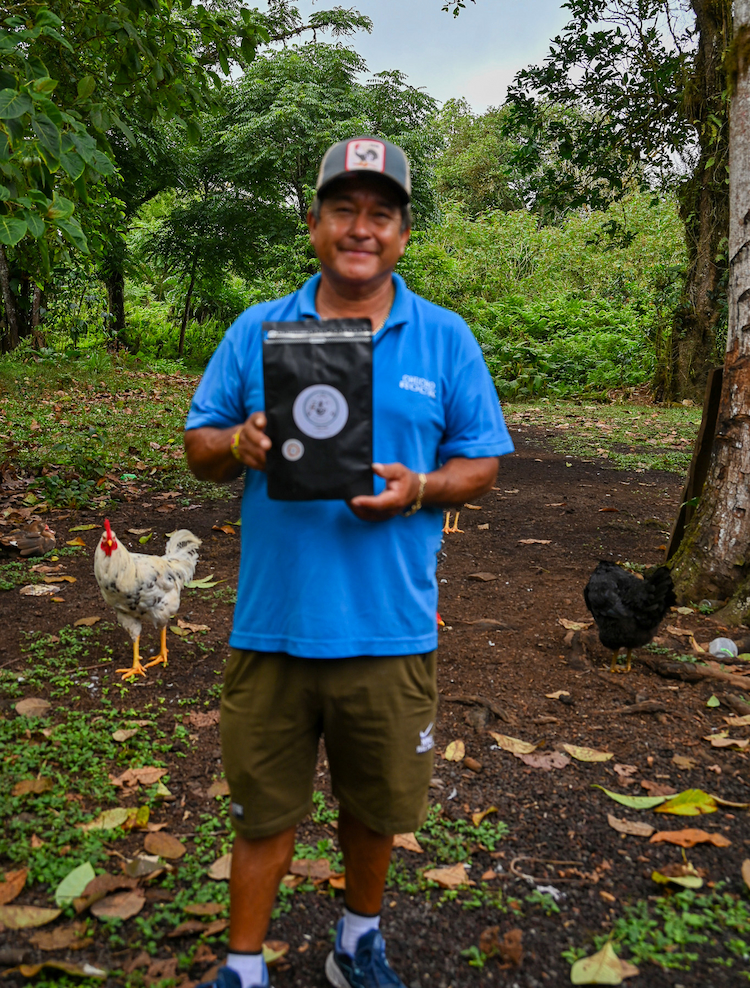
Don Flavio has been working on the once-abandoned coffee fields and diversifying the property. Besides coffee, the farm now includes a garden area with a wide variety of crops such as tomato, peas, onion, celery, bell pepper, red and white beans, cabbage, beetroot, cassava, corn, spearmint, mint, and more, and he is currently focused on producing quality over quantity. Last year, he harvested around three quintals of coffee (about 650 pounds), and this year he expects to reach five to six quintals, as the coffee plants are improving and the harvest looks more promising. Flavio explained that the farm is connected to local efforts that strengthen coffee production on Isabela, working alongside organizations, such as IOI, which support the coffee farms currently producing on the island.
Las Merceditas Coffee Farm: I returned to the place where I was born.
“I was born here on this land,” said Don Lincoln Moscoso, the owner and manager of Las Merceditas, “and my sister, brother, and I inherited it. Now I’ve been growing coffee for about seven years. The work of clearing the land was difficult, but I found coffee plants that were about 60 years old, so once the weeds were cleared, the plants became healthy again. That’s when I kept going.” Don Moscoso explained that the success of his coffee depends strongly on the guava fruit because guava provides the ideal shade and contributes nutrients that help the plants stay healthy and green. Guava can even influence the flavor of the coffee. “That is why we say that a coffee plantation without guava is not truly a coffee plantation,” he said.
Breeding Tortoises on Isabela: Local Staff and Volunteers at Work
When settlers first started coming to the Galapagos Island, they brought goats, which became the most destructive invasive species because they consumed native vegetation needed by the tortoises. In addition, cattle, donkeys, dogs, and pigs (which ate turtle eggs,) further disrupted the fragile ecosystem of the Galapagos Islands.
IOI supports the Arnaldo Tupiza Chamaidán Tortoise Breeding Center in Puerto Villamil by bringing volunteers to assist with the Center’s activities: locating nests to transfer eggs to incubators where they have a higher probability of survival; feeding, weighing, measuring, and recording the tortoises and the populations they belong to; cleaning the tortoise lagoons; maintaining the enclosures; and transporting tortoises by truck to be released back into the areas where they belong.
Efforts by organizations like IOI and its involvement in and support for programs such as eradicating invasive species, preserving habitats, encouraging sustainable tourism practices, strengthening community involvement, and organizing volunteer efforts - all are contributing to keeping the Galapagos Islands pristine and thriving well into the future.
Bringing Back Scalesia from Extinction and Restoring an Ecosystem
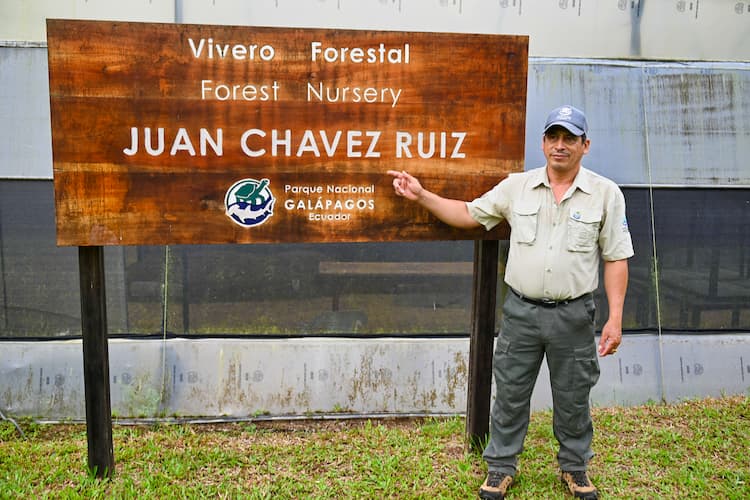
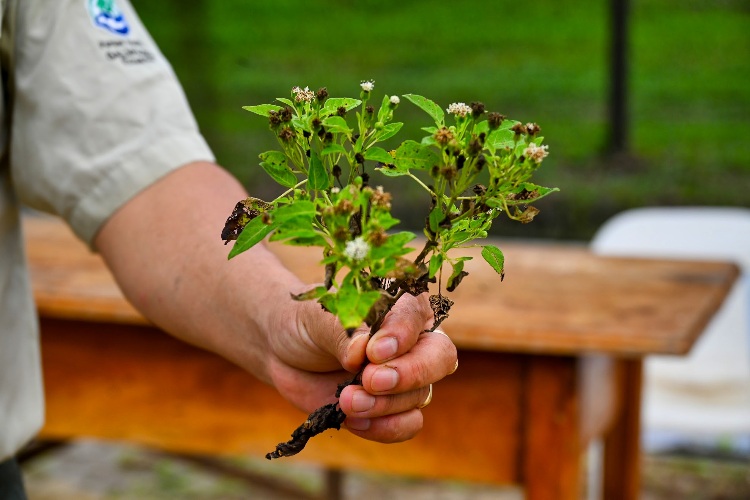
Across a field from the entrance to the Cueva de Sucre, a cave making up part of the Galapagos National Park, a large plant nursery and its dedicated staff work on a reforestation project - the restoration of an entire ecosystem, not just that of a single species. In the building, visitors see where thousands of Scalesia seedlings are growing, and when strong enough, they will be replanted across the Sierra Negra and Cerro Azul volcanoes, where the Scalesia forest once thrived. Many conservation projects focus on just one species, but this project is restoring an entire ecosystem. The Scalesia forest served as a vital ecosystem, sustaining a network of endemic life such as insects, birds, and plants that rely on the microclimate of the region. An almost lost ecosystem is on its way back from extinction, and the thousands of Scalesia seedlings are the key to bringing it back.
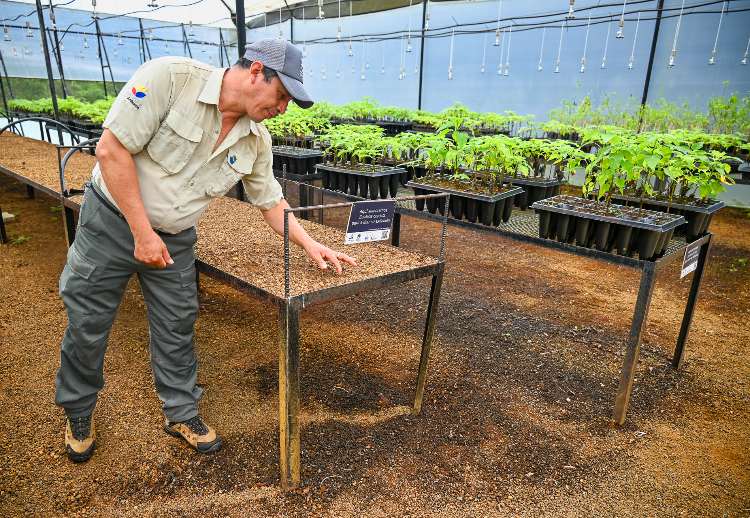
According to the park ranger managing the plant nursery, Cléver Jiménez, “For the nursery work, we manage soil and earth from the beginning. We tested soil until we identified that a certain type of soil works especially well for Scalesia.” Don Jiménez went on to explain that the soil for this project is organic and natural without chemical additives. The heat generated by the plastic encompassing the nursery helps to sterilize the soil and, as a result, there will be fewer weeds. Scalesia needs four to five months of healthy growth before it is ready for reforestation, but once planted, Scalesia trees, which produce daisy-like flowers, will provide habitats for endemic bird species, insects, and other flora. Because the Scalesia trees play an important role in the island’s water cycle, their dense vegetation helps maintain soil moisture levels, and at higher levels, Scalesia is responsible for fog cover, an important part of the micro-climate.
Ranger Jimenez concluded by saying, “The importance of the species is that it is endemic to Isabela. If it disappears from here, there is no way to recover it from another place. If it goes extinct, it is gone.”