
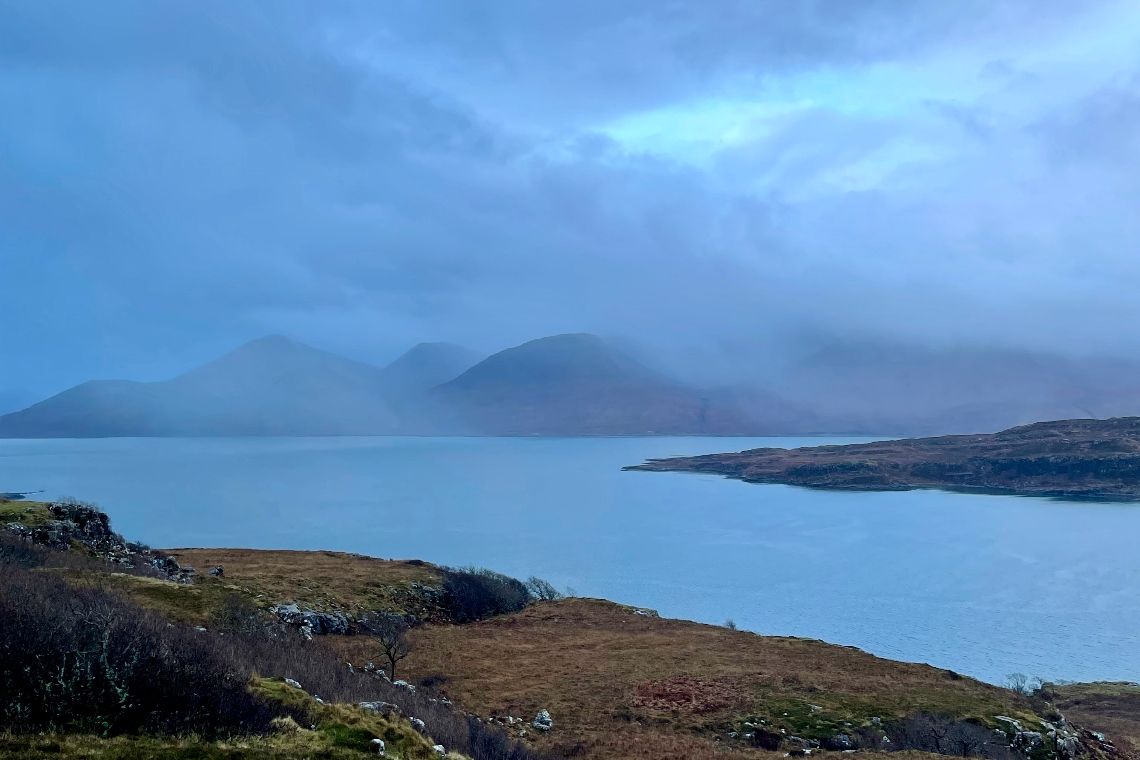
In the middle of December, my partner and I day-tripped to the Isle of Mull in Scotland. We journeyed in many layers, and with a concurrently ambitious wish list: to see our first eagle, and as much of the island as possible, all within the flash of daylight that was available to us.
The island is 30 miles from south to north, and so is about commutable by car; it is also home to the highest density of eagles in Europe, and so is a seductive place for allowing the usual pragmatic restraint to unravel into a dangerous thing for wildlife enthusiasts — hope. Because of their size, power, and pure aesthetic beauty, eagles are what we might affectionately call (and what some lesser-appreciated species in conservation might bitterly call) “charismatic”.
So, despite the troupe of wildlife flaunting at us, an eagle is what we hoped to see — after catching the ferry from Oban to Craignure, we set off along the eastern coast of the island toward the beautiful coastal town of Tobermory. Both of our nations' eagles live on Mull. The white-tailed sea-eagle (Haliaeetus albicilla), the largest bird of prey in the UK and one of the largest in the world, prefers the coast during winter. This is where they find their vital food sources of seabirds and fish. We journeyed along this coast, on the lookout for distinctive features. Their name suggests this would be a white tail. But, with a wingspan of up to 2.5 metres, it was their nickname that could prove to be the most illuminating — locals call white-tailed sea eagles the “flying barn door”.
All of the white-tailed eagles in the UK are descended from reintroduction programmes. The UK’s original population were illegally persecuted, and, by the early part of the 20th century, they had gone extinct. Their fate changed in 1975, when a Loganair islander aircraft landed on Fair Isle, with chicks from Norway, to reintroduce the species. Projects on other Scottish islands followed, and are still being implemented in different parts of the UK today.
Their extinction, and well-documented reintroduction, was given extra reverence last year when the original project turned 50. One legend in this story — Dave Sexton — turned up on Mull in 2001 on a 12-month contract to help facilitate the birds' protection.
Dave never left, and neither have the eagles.
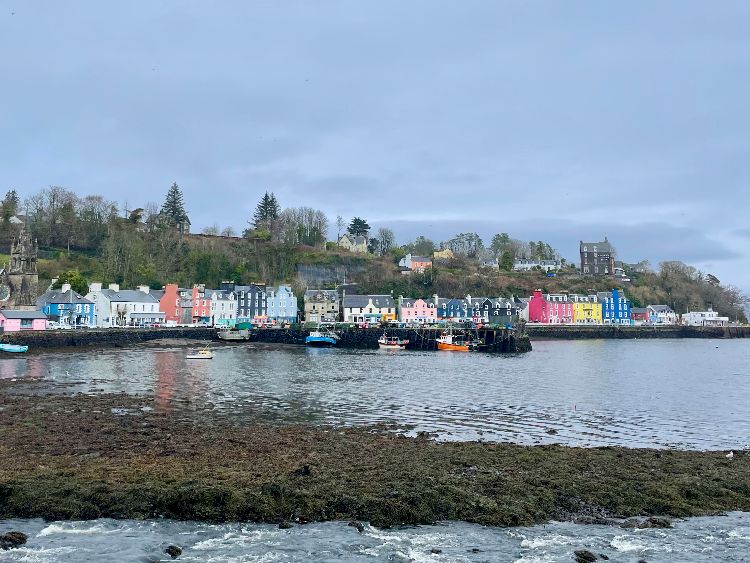
No luck for us, however — eagle-less (but certainly not bird-less, and no longer hungry) at Tobermory, we banked round the north of the island before heading down toward Loch Na Keal — a known hotspot. White-tailed eagles prefer trees or sea cliffs, where they nest in large “eyries”. The island’s other eagle, the Golden Eagle (Aquila chrysaetos), favours remote moorland and mountain ledges; both of which are in abundance on the way to, and surrounding, Loch Na Keal. Unlike the Sea Eagle, which can be more tolerant of human activity, the Golden Eagle is an elusive bird. This elusivity meant they were harder to persecute, and the populations (in Scotland, at least) managed to survive through the protection they are afforded today.
Across the north we drove, passing between mountains, and snaking round the ancient volcano of ‘S Àirde Beinn (at one point passing a cyclist, climbing with an esoteric stoicism and completely indifferent to the rain). Around us, at this point, was predations biggest and most controversially guarded protectorate — livestock. Both eagles can, and sometimes do, eat livestock, but whether or not they cause actual deaths to these animals, or just take advantage of a pre-existing carcass, is often hard to discern. To help mitigate this impact, in 2015, the Sea Eagle Management scheme was launched. This advice helps farmers and crofters on how they can alleviate any potential harm, and provides support for the longer-term management of the land.
We arrived at Loch Na Keal. After stopping at various viewpoints and eventually squinting through the dusk, we began to head back toward Craignure to catch the ferry home. Along the remaining roadside, banked by vast mountainous ranges, a sliver of light remained. There was still hope, but very little.
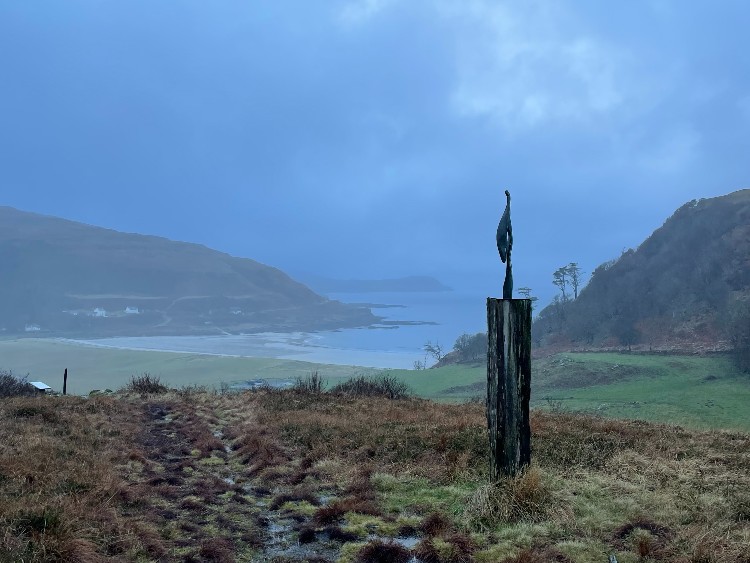
During that day, I recalled listening to a neuroscientist talk about how our brains will take into account contextual information to explain the environment using the input our senses receive. He highlighted this with a personal anecdote in which a guide revealed to him that the forest they were walking through at dusk contained bears. Suddenly, the peaceful twilight morphed into a labyrinth of bear- shaped trunks, bear-shaped rocks and bear-shaped shadows…
On Mull, we were without a guide. Charged with complete ignorance about where these animals actually were, the effect this neuroscientist describes was delightfully antithetical. As we hopped along the islands' many viewpoints, forest walks, and extremely well-kept hides. The views were genuinely breathtaking (a word too commonly used to invoke its own imagery, but they were breathtaking, when you look out at Mull, that is exactly what happens — for a moment, you forget to breathe). But it is the inhabitants of this landscape that produce the effect.
That kinds of sustained, rushing expectation of an encounter — the heightening of the imagination that Scotland’s biodiversity distils in you.Where every craig becomes an eagle roost, and every shoreline an otter's commute, and every wave or splash a porpoise (an enquiry that, in our case, did in fact prove fruitful). After we pulled into the ferry port, we resigned ourselves to the arrival of night, and the day was still a manifesto for the experiential benefit of biodiversity. And you don’t have to see the animals; it is simply enough to know that they are there.

