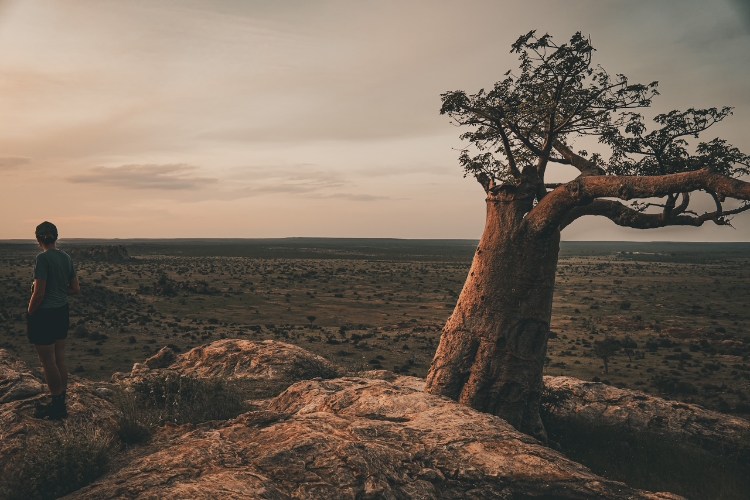
On the other side of the rusty gate, baboons roam along the dirt road, clearly unbothered by the four of us cyclists, Flo and me, accompanied by our guides, Max and Kenny from Horizon Mountain Biking. The gate swings open, and off we go into an unprecedented adventure. Mountain biking through the Mashatu Nature Reserve means sharing the trails with creatures, big, small, and ugly. Yet, as it turns out, the bush does not conform to the tidy expectations of a bucket list. It soon becomes clear that this experience is about something far greater than any checklist.
To truly understand our journey, it is essential to consider where we come from. Austria is one of the wealthiest countries in the world, with a highly developed social system that effectively caters to most fundamental needs. However, there is something even more valuable, something that forms the very foundation of life and well-being on this planet, that Austria, and indeed much of Europe, largely lacks: vast, intact ecosystems. What we often regard as “nature”, basically cultivated fields and straightened rivers, stands in stark contrast to what we encounter at Mashatu.
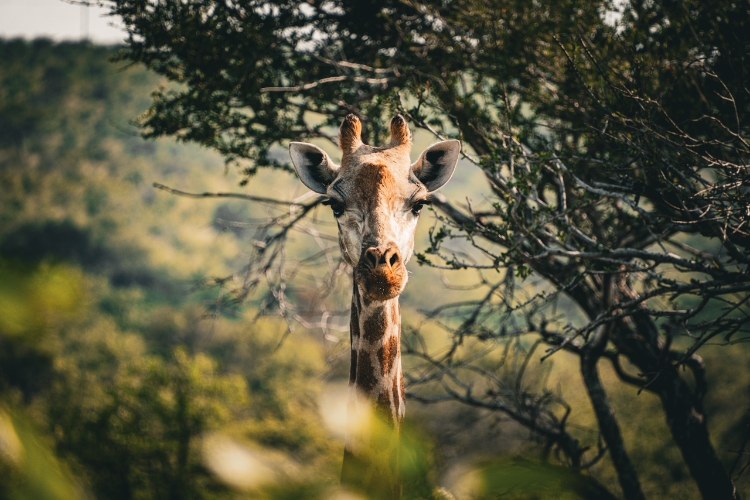
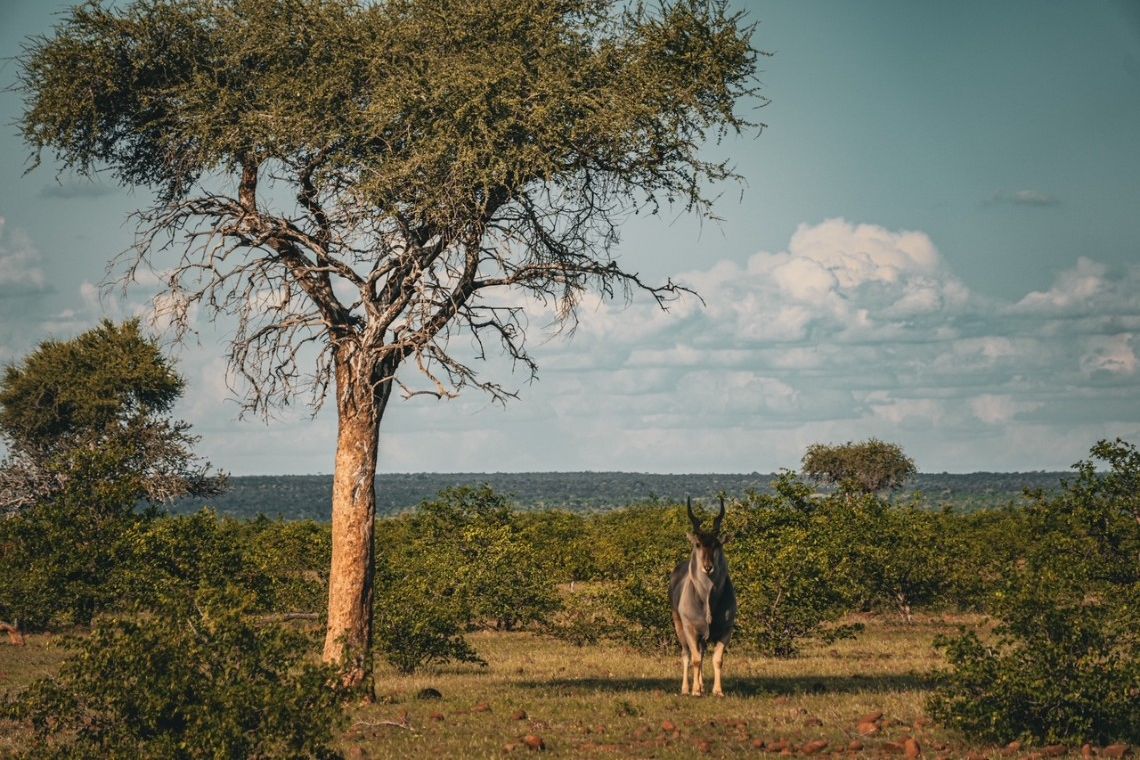
We are left speechless by the diversity we witness within the very first pedal strokes of our ride: giraffes, eland, zebras, springboks, impalas, baboons. We do not spend long on the gravel road before Max leads us off into the bush. No trails, no paths, tubeless tires mandatory. He explains that rainfall has been different this year and that we might not see elephants. With sufficient water available, they have little reason to migrate into this part of the reserve. Yet about two hours into the ride, we encounter our first herd. Calm and serene, they move across the landscape, feeding on mopane trees in the distance.
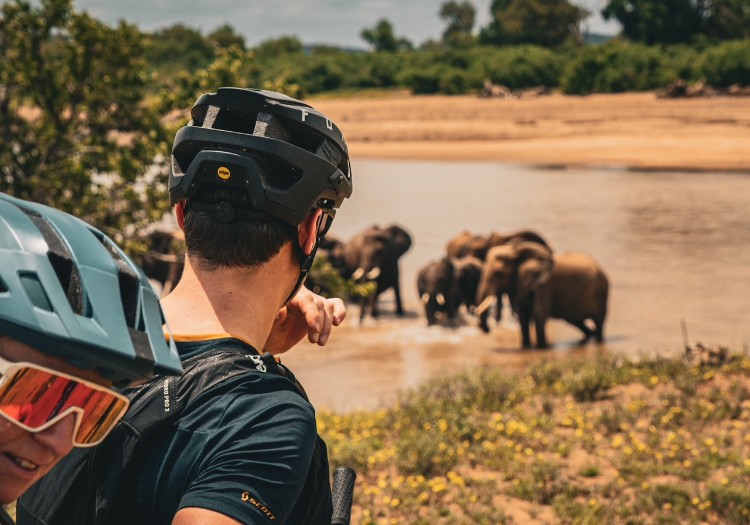
As we would soon learn, they remain peaceful only as long as they do not perceive an intruder. While observing a group cooling off in a river, we cautiously move closer, aided by our slightly elevated vantage point (just in case). Nothing happens at first. Then, our scent reaches the herd. One by one, the grey giants lift their trunks, turning toward us. Within moments, they begin to approach.“Come on, guys! Let’s go, go, GO!” Max commands. We turn and ride hard in the opposite direction. People who are used to encountering wild animals often rate elephants the most dangerous ones, and for me, there is no doubt about how they reach this conclusion.
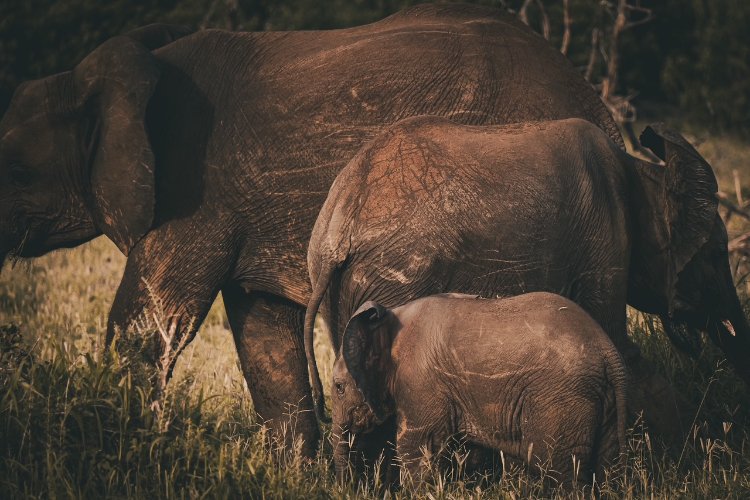
It is not the only time these remarkable animals remind us that the bush belongs to them, not to us. In the Western world, we have reshaped nature to play by our rules. Here, it is unmistakably the other way around. The strength of elephant society is evident not only in their protectiveness but also in how they respond to death. They pause when a member of their herd dies, lingering and interacting with the remains, scattering bones, touching them. Behavior that reflects their intelligence and suggests an awareness of loss.
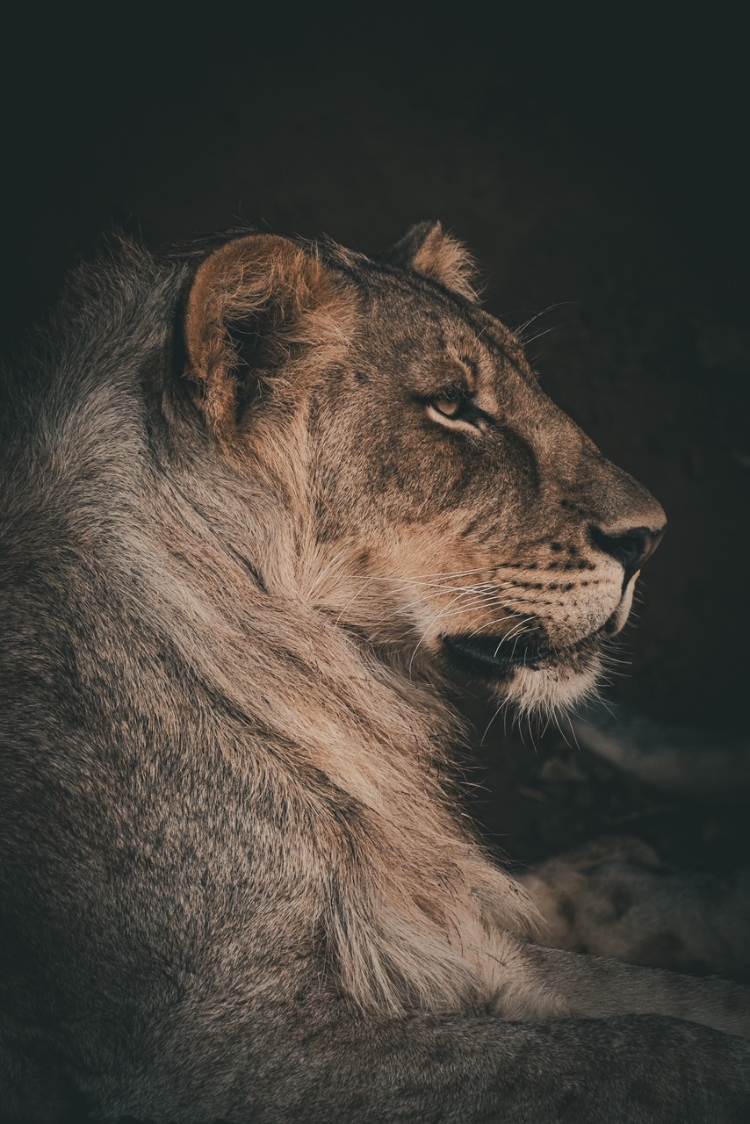
We spend four nights in the reserve, staying at two different accommodations: Treehouse and Kgotla. To avoid the heat, we rise early each day. There is no need for an alarm clock, as the sounds of the bush gently usher in the morning. One day, it is the roar of a male lion calling his pride, another, the crack of an elephant snapping branches from a mopane tree just meters behind our bed. No matter how many fences are built, the wildlife makes one thing clear: we are guests in their territory, as it should be.
Horizon Mountain Biking ensures that our journey is truly once in a lifetime. They take care of everything from delicious meals to sundowners in breathtaking locations and, most importantly, they keep us safe as we navigate the bush on two wheels. In the evenings, we set out on game drives, where Max consistently literally goes the extra mile to make each outing unforgettable. Conversations with Max and Kenny about conservation, wildlife, and Botswana add a layer of depth to the experience and help us understand. I am deeply impressed by their ability to read the landscape and its inhabitants, which is an essential skill for our safety. Where we see a grey roadblock, they see the safest route through the elephant herd. Where we see a zebra, they see evidence of a functioning ecosystem. Where we see a log, they see a crocodile.
Each day, we spend hours in the saddle, passing countless wild animals. And yet, despite seeing bones of every conceivable size and shape, we never encounter a carcass. For me, this becomes the most compelling proof that we are in a fully functioning ecosystem. Every element is in place, fulfilling its role: herbivores, carnivores, apex predators, scavengers. I cannot help but think of Austria and of what has been lost. We have eradicated apex predators such as wolves and bears, and when they attempt to return, we label them as “problem individuals” to justify killing them. Of course, coexistence with elephants and big cats is not without conflict. But here, effective communication about the importance of conservation has fostered widespread acceptance and support from local communities.
The Mashatu reserve lies at the intersection of Botswana, South Africa, and Zimbabwe, illustrating the necessity of cross-border conservation not only on paper but in reality. The behavior of the elephants reflects their past experiences: some are unbothered by humans, while others remain wary, shaped by encounters with violence or disturbance, particularly in areas where hunting is permitted. Ensuring the safety of both animals and humans requires coordinated efforts that extend beyond political boundaries. What seems like a no-brainer becomes living proof at Mashatu.
After four days in the bush, returning to our starting point feels surreal. Could I have imagined what awaited us on that morning when we rode through the rusty gate? Not a chance. I leave with far more than photographs of lions, elephants, giraffes, and zebras. I carry with me a deep sense of gratitude for the experiences, the insights, and the thoughts that will linger in the weeks ahead. As we hug Max and Kenny goodbye, I realize I am not ready to leave.
In the end, we are left with a fundamental question: what kind of world do we want to live in? One where profitable monocultures take precedence over vast, self-sustaining landscapes? Where human space is valued above that of other animals? Where short-term profit outweighs long-term balance? Where fear of wildlife beats fascination and respect
The choice is ours...