
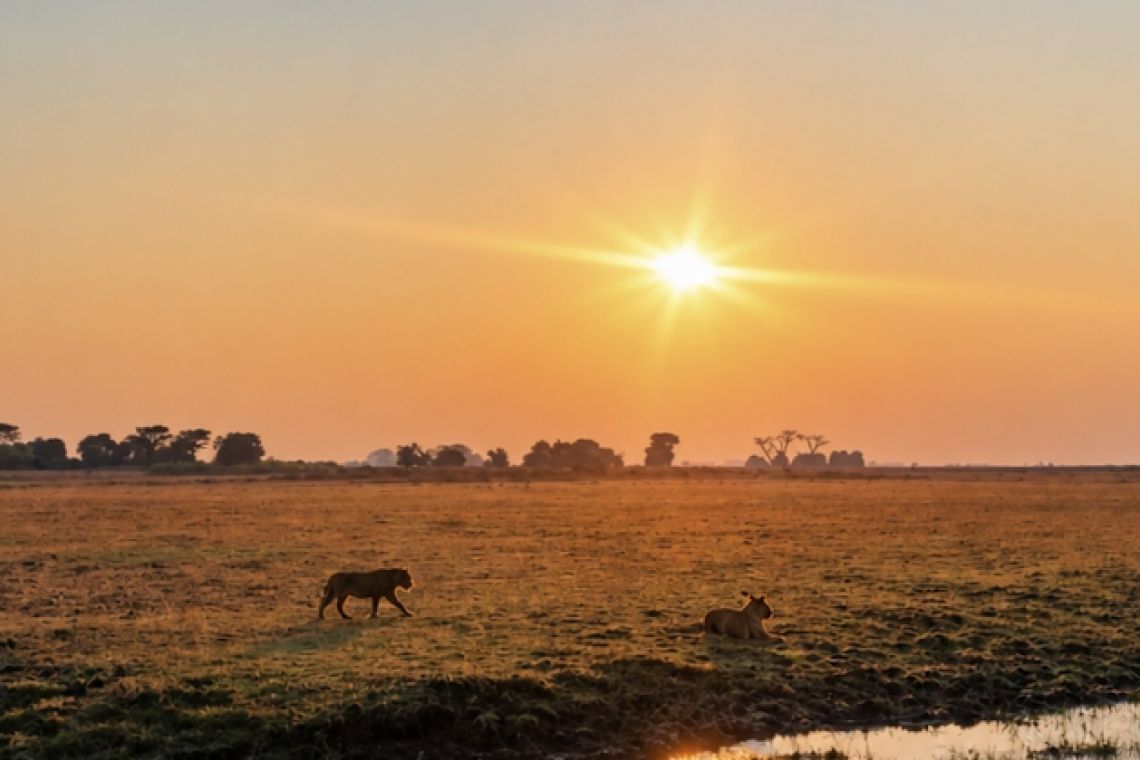
Our first game drive in the Busanga Plains began with very little happening. We sat scanning the endless grasslands with binoculars, in a ritual that would become a customary pause over the next few days.
“Scan complete. Nothing detected.” That's not to say there wasn't any life.
Puku and lechwe moved around us. And while we'd been delighted to see them just hours before when we touched down in Zambia's largest national park, eager to learn each minute detail of how these two very similar antelope differed, they'd somehow managed to morph into the landscape, despite being present in the thousands.
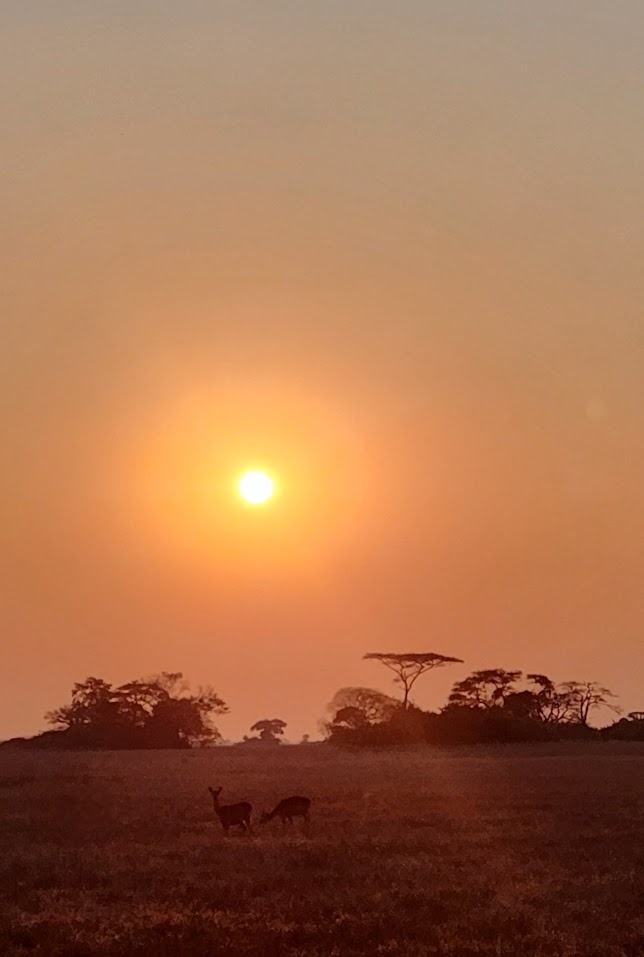
However, our guide, Isaac, was piqued. “Listen”, he said. The distinctive alarm whistle of a puku. Not a lechwe, who prefers to snort as a warning. Isaac refused to give up. Having guided in Kafue for almost 20 years, his gut is seldom wrong. He scanned again before finally pointing into the distance. “Look. There, with your binoculars”.
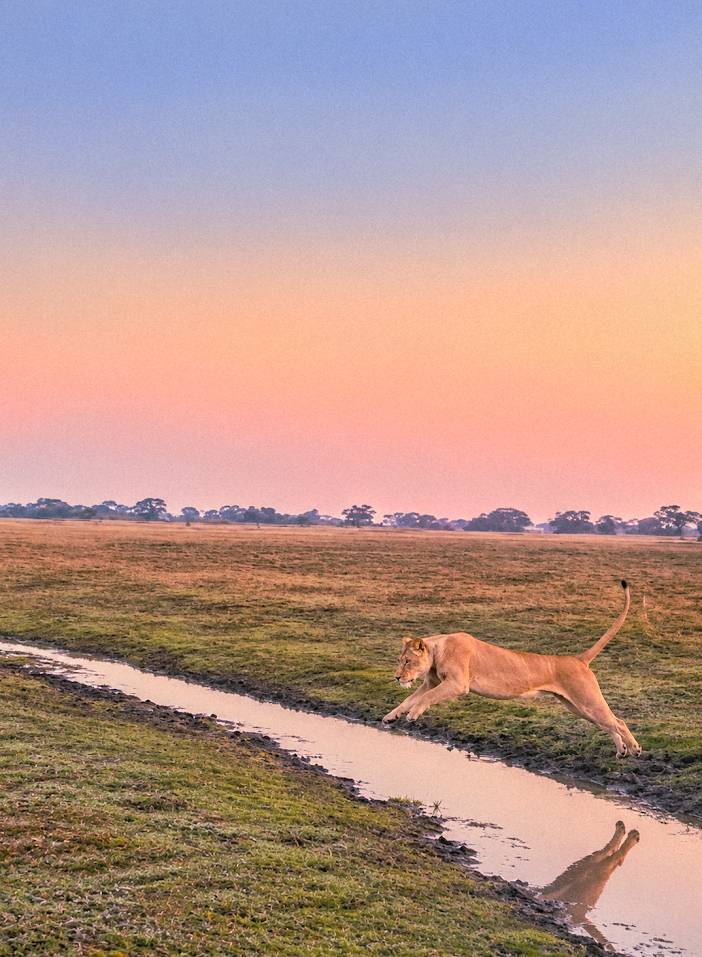
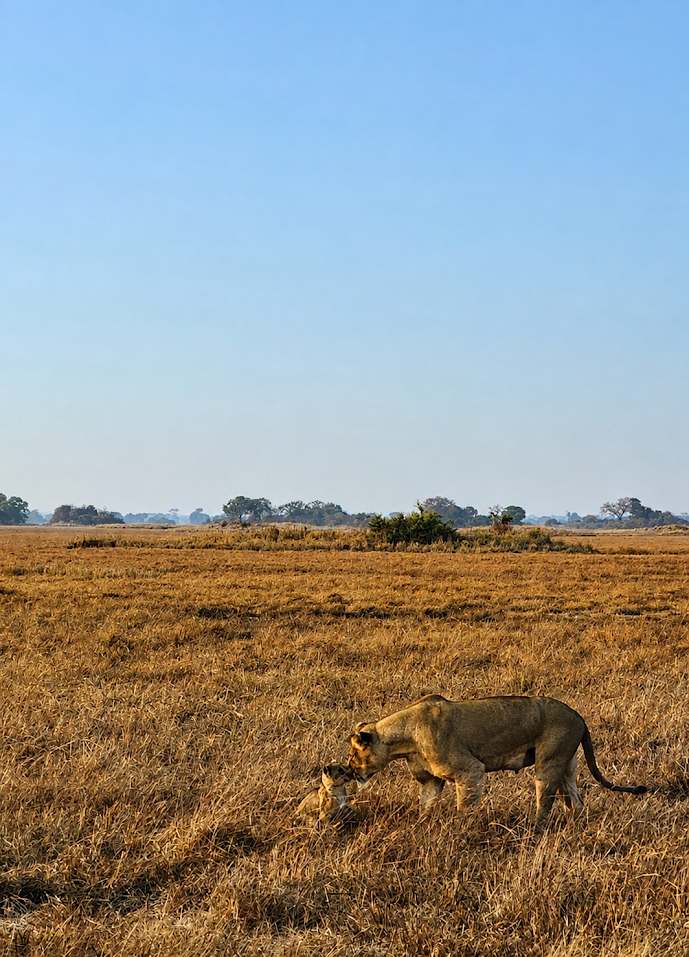
And there she was. A lone lioness. Impossible to spot with the naked eye. She drew closer, disappearing into a culvert and for a few moments, all we could see was the tip of her black-tipped tail swishing above the ditch. Then she emerged, heading straight towards us. In fact, Isaac had to reverse to give her a little more room. Without hesitation, she leapt over the channel in that wonderfully characteristic style of Busanga lions.
By now, Isaac had told us about a lioness recently seen with five tiny cubs. Because the camps here only operate for five months each year, the guides return to a landscape where the lion dynamics can be completely different from the season before. This year, along with the mama of five, they had also met one lioness with three cubs.
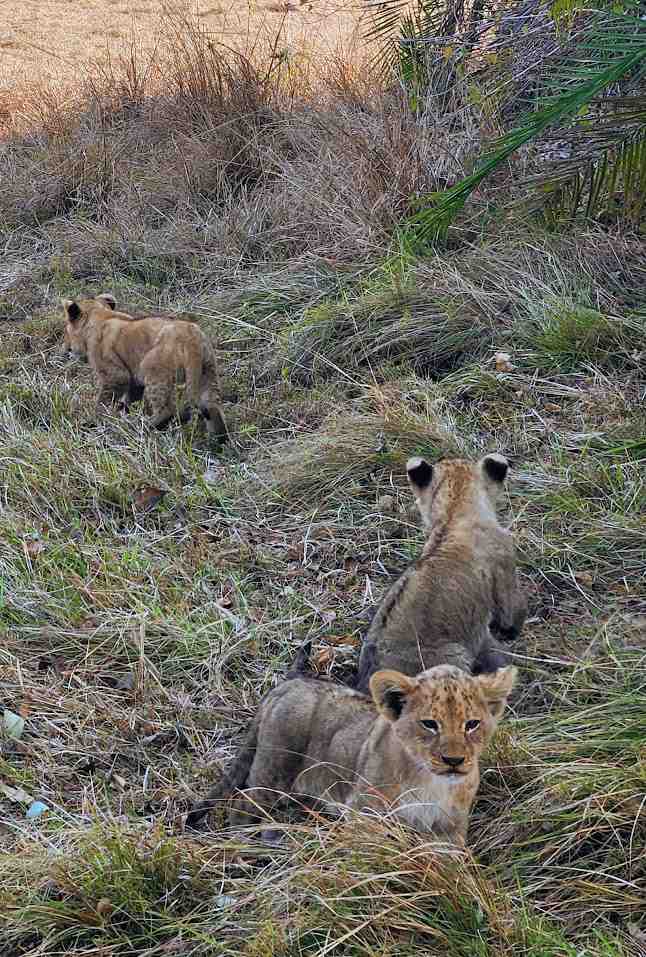
Her swollen teats had given her away as a mother, and I wondered which one might be in our presence. As if on cue, she began to vocalise, calling softly. And then from behind us, five tiny cubs appeared - less than 20 metres from the luxury safari tent at Wilderness Shumba in which I had spent the night. Perhaps they had even spent the night tucked away in the grass, listening to us snoring (and by us I mean other guests; I don’t snore).
One after one they tumbled out of the vegetation to meet their mother, jumping on her, rubbing against her and calling excitedly. We followed the lioness and her five cubs for some time, getting to know the little personalities within this tiny pride. There was the bold one, racing ahead of the others, determined to lead the way. A little one who wanted to be close to Mum, seeking a reassuring nudge or a moment of affection, and getting under her feet in the process. And the mischievous one who seemed to prefer hanging back, waiting until the very last moment, then bolting after the others, with a little stalking manoeuvre thrown in for good measure.
We followed them until they disappeared into a bushy island. And as we rounded, expecting to pick them up again, we found ourselves looking at a different lioness.
Isaac had explained that the two lionesses had been spending time in proximity. Both lionesses were around three or four years old and first-time mothers. There was a strong possibility they were sisters. Yet despite having frequently seen one another across the plains, Isaac said they'd never joined up with the little ones in tow. At least, not that anyone had witnessed. Yet.
Having two little girls of my own, I could imagine that raising three cubs is no small task. Raising five little ones as a single mom is quite another matter.
But lionesses in these parts tend to distance themselves from larger prides to protect their cubs from infanticide. There was no guarantee that either mother would welcome another female, or her cubs, into her space. But our anticipated reunion seemed to be over before it even began. The lioness with triplets began walking away, her little family trailing behind her. One cub, however, lagged, glancing back as though hoping that someone might turn this into a playdate. Having reluctantly left my own kids at home, I recognised my social-butterfly older daughter in her. And her subtle invitation to play was all the encouragement needed.
Two of the original five sprinted forward, eager to investigate new potential playmates. Their mother followed, stepping into the path of the other lioness, closing the distance between them. Closer. Closer. Until the two mothers were almost walking side by side. It was wonderfully, almost comically, anticlimactic. There was no snarling. No growling. No confrontation. No dramatic display of dominance. Instead, they simply brushed against one another and carried on walking.
Behind them came eight tiny bundles of energy; tumbling, chasing, stalking and playing.
The following morning, we set off early once again. By this point, my phone needed to be plugged in permanently to avoid crashing due to lack of space (cue taking my laptop on a game drive as I had foolishly left my power bank behind), while my travel partner deleted her entire Spotify and all her downloaded playlists to make space for more lion cub videos.
Isaac had a particular area in mind for the drive, and he headed to what was known as favoured hunting ground for our young mothers.
When a lone puku began her alarm whistle, we stopped. And scanned. We drove around, searching the grasslands and circling islands of vegetation, but there was no sign of the lionesses. A bit disappointed, we began to make our way out. Then, a face looked up at us from the grass. In the exact area we had already driven through. Where she had come from, or how we had missed her - a mystery. On the other side of a small, dry river channel, four tiny cubs sat together in the grass.
Then the other lioness emerged. Her face was mottled red. Looking more closely at the lioness already lying near us, we noticed patches of red around her face and on her paws. The cubs began to approach their mothers. One. Two. Three. Four. Five. Six. Seven.
And although the cubs were a bit too young to be eating meat and were still dependent on their mothers' milk, their plump little bellies, combined with the blood on both lionesses, told us that everyone was feeling happily satiated this morning.
The two lionesses settled down together, with the cubs immediately taking advantage of having both mothers within reach. Lionesses will, when necessary, nurse one another's cubs, and there was certainly no shortage of little mouths to feed. However, while one mother would lie relatively peacefully, with just one cub feeding - her breastfeeding journey the picture of peaceful contentment - the other seemed to have drawn the short straw. One cub clambered on. Then another. And another. Soon six little bodies were scrambling over her, their tiny roars, squeaks and impatient noises growing louder and louder as they competed for their turn.
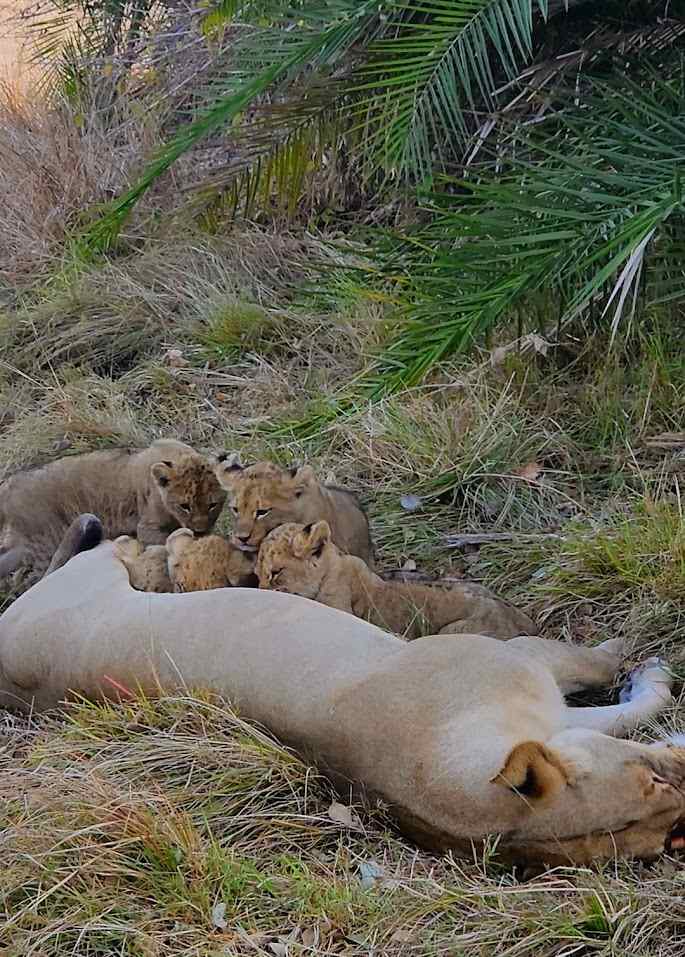
Eventually, Mum had had enough. With a definite shove, a loud growl and plenty of bared teeth, she sent the whole lot tumbling away. Hard relate.
Then from behind a clump of grass, came number eight, stalking his siblings.
My final day in Kafue National Park began at Wilderness Busanga Bush Camp, an intimate, rustically authentic camp with just four tented suites on the ground. I’d spent the night listening to lions roaring in the darkness, and by morning, there was evidence that they had been even closer than I realised: fresh prints that I had to step over to walk to the game drive vehicle.
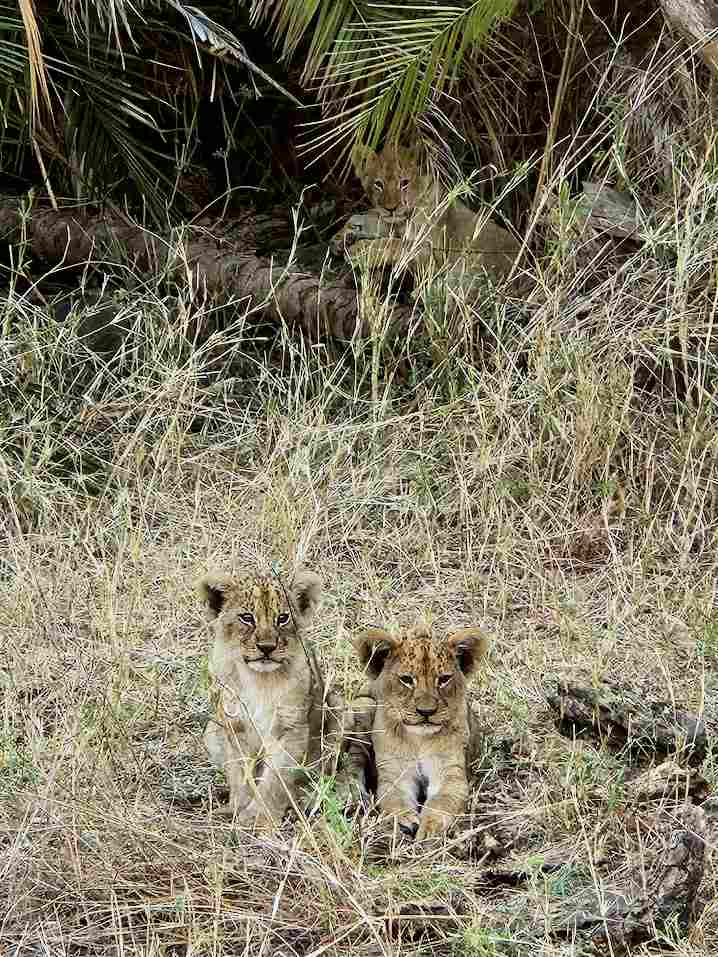
There was only one thing to do. Go and find them. Rounding an island of beautiful palm trees, we spotted two tiny cubs completely alone. After the cacophony of the previous day, the silence was striking.
Had we not seen them, we would never have known they were there. However, by this point I was less convinced that it was pure luck and more about the remarkable ability the Wilderness guides have to read the land and their pure, wild instincts.
Then we spotted a third. Deep in the bushes, on a fallen tree log, he was inching his way towards us. At one point, his back legs were still balanced on the log while his front legs stretched towards the ground, looking as though he might topple off.
We stayed this way for a long time, debating whether to head off for a beckoning G&T. But curiosity had got the better of this cat. I wanted to know what had happened to Mom. When the three little cubs began to move away, we followed them. Emerging from the thicket, we spotted the two lionesses and the other five cubs alongside a stretch of water.
They immediately ran to join their family, and for a moment one mother was surrounded by eight tiny lions. They jostled around her, growling, chirping and making the most adorable noises.
The other lioness was focused on one thing. The water. She edged towards the water, the little ones now following, only to be repeatedly nudged and pushed back. At first, we couldn't understand why. The water appeared quiet, with only the occasional hippo breaking the surface. But there, just above the waterline, were two sets of eyes. Crocodiles. Big ones.
The mother's eyes never left the water. Every movement was monitored, every cub kept firmly under control. At one point, one crocodile moved alarmingly close to the edge. The cubs hovered nearby, but Mom wasn’t having it. She growled. The crocodile thought better of it and retreated into the depths. The Busanga lions have been known to kill crocodiles.
These young mothers, who only days earlier had been navigating the challenges of raising their tiny broods as single moms, were now standing guard together against one of the most formidable predators in Africa.
Eventually, with the sun beginning to sink, the lionesses decided that waiting for a safe drink wasn't worth the risk. Gathering their cubs, they disappeared into the long grass. And that was where we left them.
It felt like the perfect ending to our Busanga lion saga. But thankfully, their story isn’t over. I’ve since received updates from the Wilderness guides on the ground. The cubs are growing fast. They’re already noticeably bigger. And, wonderfully, all eight are still together.
Sure, every time the guides return to the plains, the story will have moved on. But for now, eight little cubs are still racing through the long grass, two mothers are watching over them, and somewhere out there on those endless plains, the next chapter is already unfolding.
I can't wait to see what happens next.

